
Scaling AI Use Cases

In brief
How does an AI investment turn into a measurable contribution to business success? That question filled every seat at Return on AI, our event with BVMW in Munich. The key takeaway of the evening: the biggest lever is rarely the tool. Whether in the panel, with voices from large enterprises and mid-sized companies, or in the four sessions, the recipe for scaling AI use cases looked much the same: a solid data foundation, shared ownership and a measurement logic set before launch. For leadership, that means AI budgets go furthest where they improve a specific decision or process, and that’s exactly where the return on AI can be measured.
Key insights:
- The data foundation sets the pace: Clean data, a reliable semantic model and clear ownership help AI results earn trust quickly.
- Measurement makes impact visible: A baseline, a comparison group and a fixed measurement date make the value of an AI use case provable.
- Rough but running: A pilot in a real workflow shows its value early. Customer-facing and regulated areas get a higher bar.
- People scale too: Training, room to experiment and trust within the team matter as much as the technology.
Return on AI: What Was the Event About?
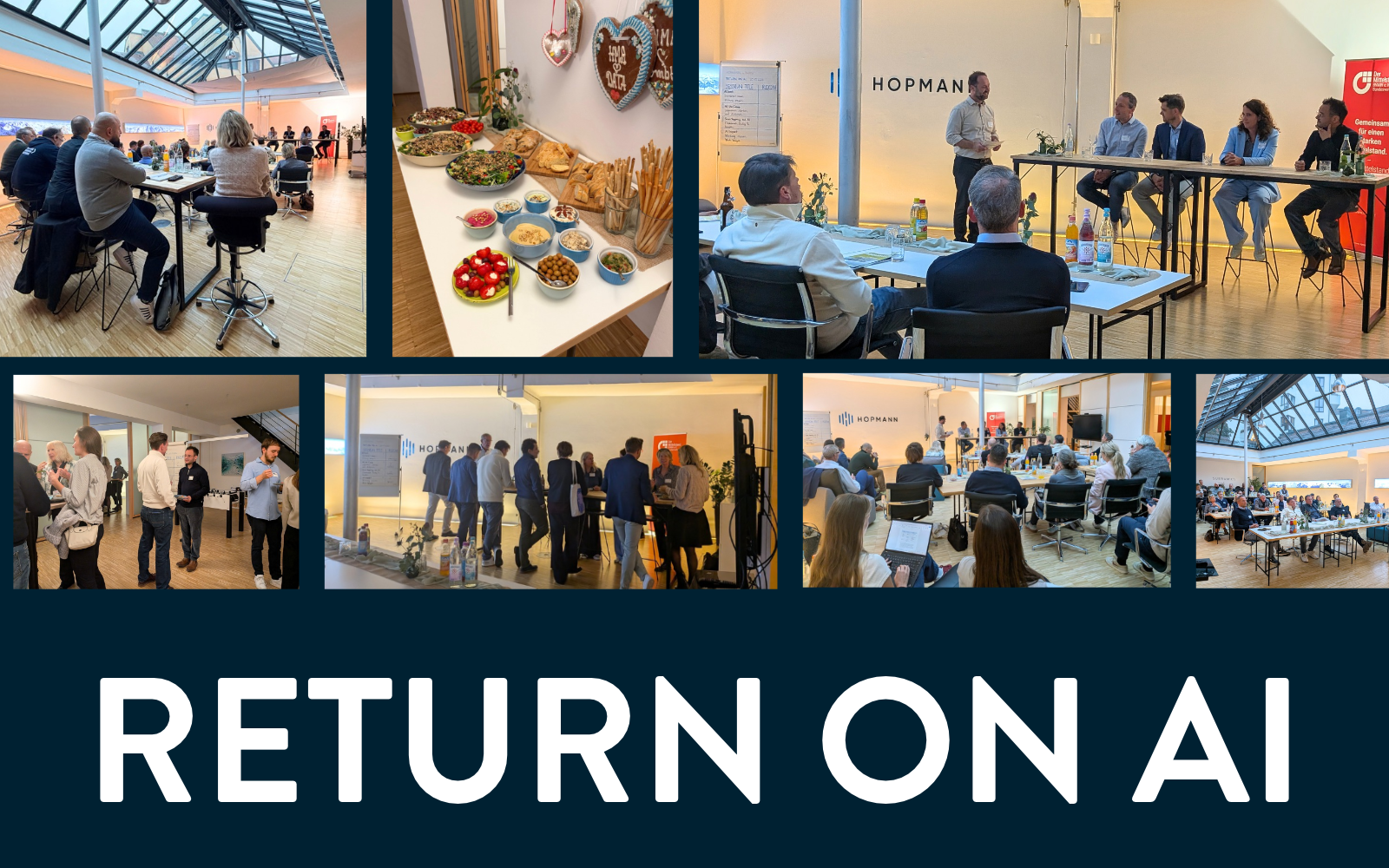
On October 20, 2026, we welcomed guests to our Munich office for Return on AI, co-hosted with BVMW, the German Association for Small and Medium-Sized Businesses. One question framed the evening: How do AI investments turn into measurable business value? Our guests were leaders from marketing, IT, data and AI. Many brought their own AI projects to the table, so the discussions got concrete fast. We previewed the topics in AI Investments That Pay Off. Return on AI builds on our summer event with BVMW, and you can read those takeaways in our recap Agentic AI at Mid-Sized Companies.
The evening opened with a four-person panel, followed by four interactive sessions where participants talked openly about their own projects.
Panel: Scaling AI Use Cases Beyond the Pilot Stage
Moderated by Jörg Hopmann, the panel featured:

Kerstin Weidenbach-Koschnike

Stefan Berge

Chris Schömmer

Israel Barcellos Pereira
The panel brought together voices from large enterprises and the German Mittelstand. Different industries, yet four points kept coming up:
Freedom with a clear target. Everyone is experimenting, often with plenty of deliberate freedom. Employees try out new tools themselves and bring them into their teams as ambassadors. Once budget is on the line, a clear target and a business case come with it. Ideas whose time hasn’t come yet go into an idea pool, ready to be picked up later.
From pilot to strategy. A pilot delivers more than a result. It shows what data the company has and where AI really helps. A strategy grows from there: which model fits which purpose, and what should AI achieve? Examples from the panel ranged from lead scoring to optimizing product portfolios to improving products based on customer reviews.
The data foundation sets the pace. The panel saw a clear data foundation as the biggest lever. Companies that invested early in data quality, access rights and context can now roll out new use cases much faster. We look at why the data foundation matters so much for mid-sized businesses in AI for SMEs.
“No one gets left behind.” AI becomes part of everyday work when the whole team comes along. That takes training on specific tools, clear rules for handling data, shared rituals and open conversations about the role people will play going forward. Compliance, GDPR and a secure sandbox provide the framework for using AI in sensitive areas and with clients.
Key thesis: AI use cases scale where room to experiment meets a clean data foundation and a clear target.
How to Prove the Value of AI

Jörg Hopmann
Jörg kicked off his session “AI Impact: Measuring Effect, Proving Value” with two questions for the room: Has AI made your team more productive? And how do you know? Two questions that got the room talking right away. The key takeaways:
- Measuring pays off: In an experiment by METR, experienced software developers estimated AI had made them 20 percent faster. The measurement showed they took 19 percent longer.
- Plan for the J-curve: Teams often need a ramp-up period after introducing AI, and the productivity gains follow. Setting the measurement date up front gives a use case the time it needs.
- Helper or transformer: As a helper, AI saves time and cost. As a transformer, it improves decisions on pricing, budgets and resources, and that’s where the bigger lever is.
- Keep using existing KPIs: When AI speeds up an existing process, the existing metrics still work, such as cases handled per hour. With new processes, the right metric takes shape over time, and with true innovation, it’s fine to start with gut feeling.
A simple illustration showed how big the gap between helper and transformer can be: if an analyst saves 20 percent of their time, that’s worth about €18,000 a year. Allocate a €10 million media budget 3 percent more effectively, and €300,000 of spend starts working harder. The actual return shows up in additional leads, revenue or a higher ROAS. Marketing Mix Modeling is a proven method for budget questions like these. We explain the basics in What Is Marketing Mix Modeling?
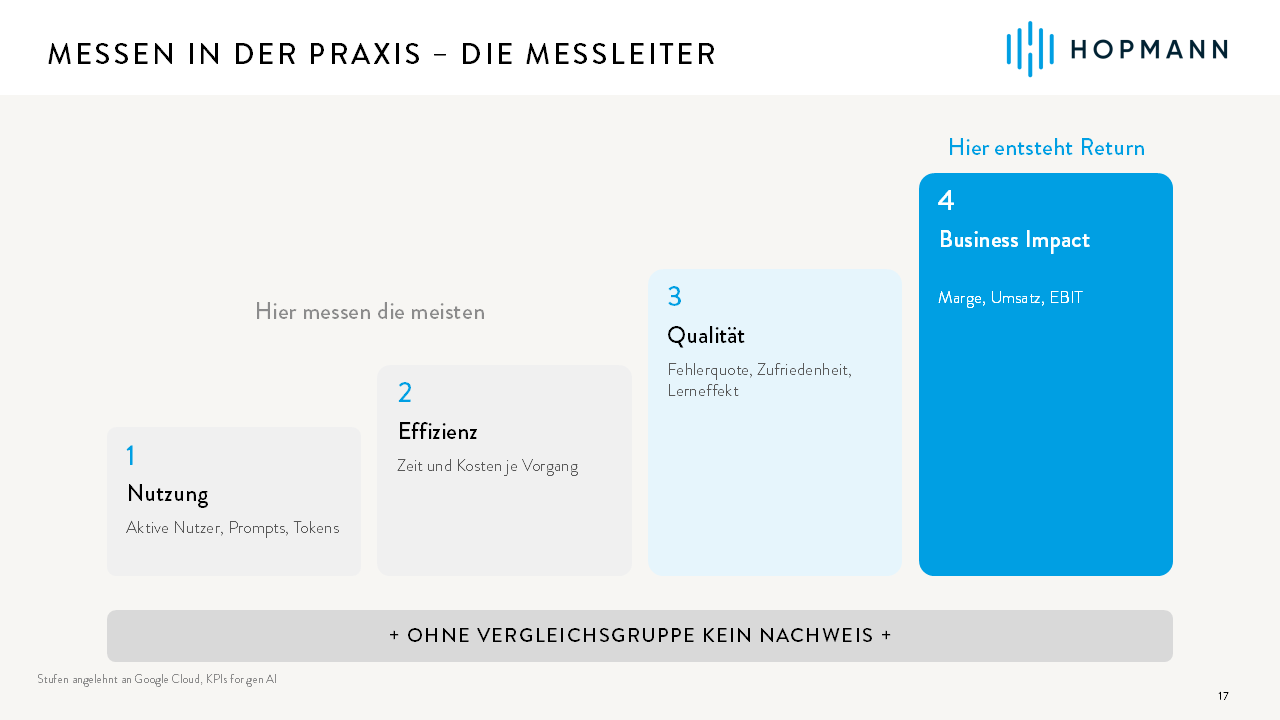
To help everyone get their bearings, Jörg shared a measurement ladder with four levels: usage, efficiency, quality and business impact. The fourth level is where the return shows up.
We explain how to anchor this logic in a measurement framework in a separate article. For an overview of proven metric systems, see our comparison of strategic KPI frameworks in marketing.
Key thesis: Define the target metric, comparison group and measurement date before launch, and you can clearly prove a pilot’s value at the end.
How to Shape AI Use Cases to Scale from Day One

Tobias Lanzl
“Starting is easy. The interesting part comes next.” That’s how Tobias opened his session “Starting and Scaling AI Use Cases.” His tool of choice was a simple value equation: affected cases × frequency × added value per case, meaning what AI gains per case, such as time saved, an error avoided or a faster decision. Subtract the cost of building, running and adapting processes. Then add the value of acting, because early movers set the benchmark in their market. AI delivers the most where it changes a decision or a workflow.
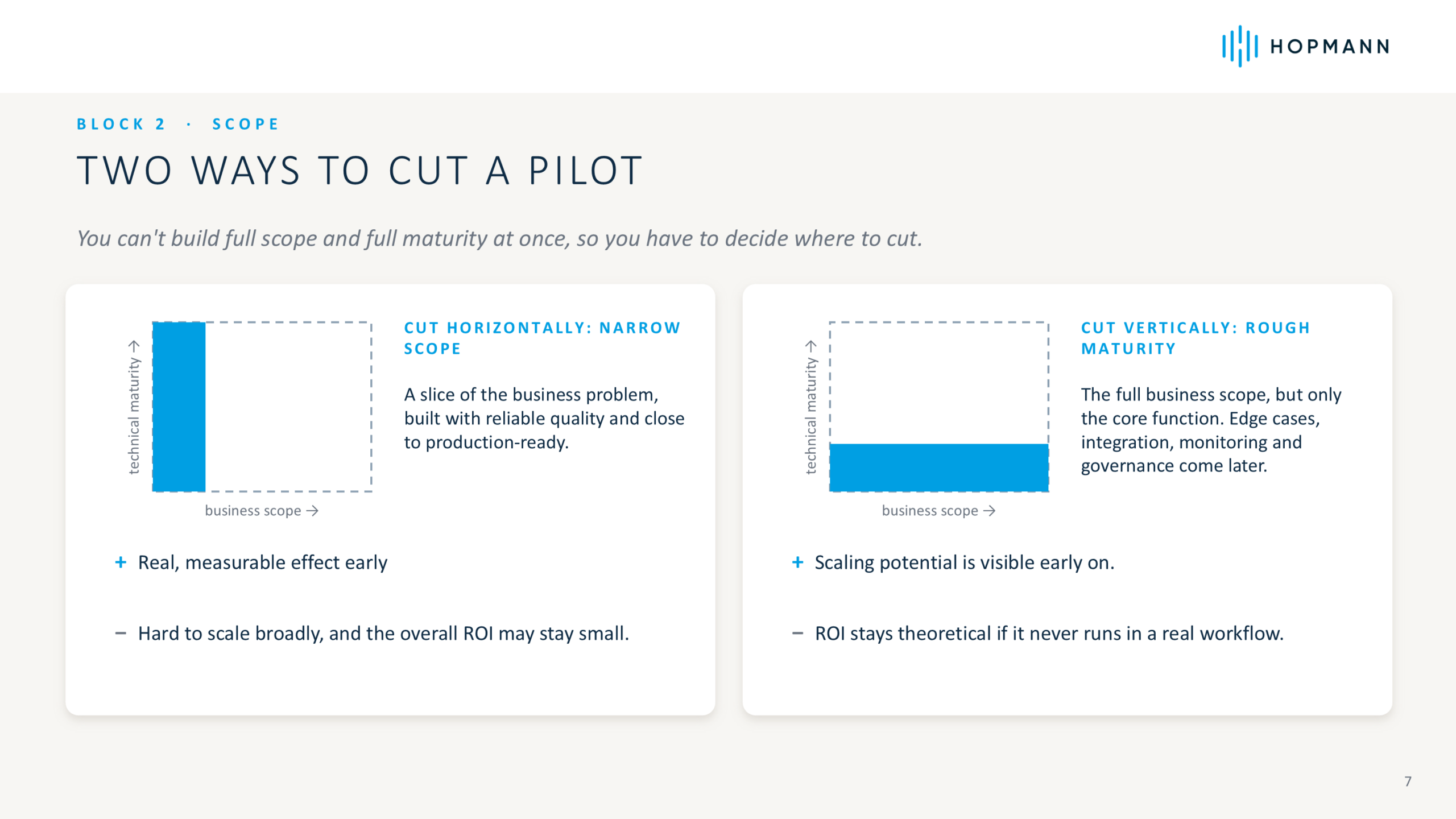
There are two ways to cut a pilot: a narrow slice built to high quality or the full business scope at basic maturity. Tobias’s rule of thumb: if the value is clear and the technology is the open question, narrow the scope. If the technology is proven and the value is still open, reduce the technical maturity: start with the core function and add edge cases, integration and monitoring later. The use case then grows along that same axis.
Tobias took four points away from the discussion:
- Shared ownership: Pilots owned jointly by IT and the business get the furthest.
- Rough but running: Asked “Eight weeks: a few cases done properly, or everything done roughly?”, the room clearly went with the solution that works.
- Clear guardrails: When results go straight to customers or regulated areas are involved, full quality applies from day one.
- Show value early: The most convincing pilots make costs and benefits visible during the test phase.
Planning an AI pilot or looking to scale an existing use case? We’re happy to be your sparring partner, from scoping the pilot to setting up the measurement logic. Get in touch.
Key thesis: An AI pilot with a clear scope and early visible value has the best shot at rollout.
Smart Reporting: Why Trust Comes Before Speed

Dr. Ioanna Kakoulidou
In her session “Smart Reporting with AI: Dashboards, Dialogue & Insights,” Ioanna walked through three use areas:
- Building dashboards faster: AI drafts calculations, report structures and formatting, and the team refines and validates. Our article on Power BI and Claude shows what this looks like in practice.
- Asking your data questions: People ask in plain language, for example in Teams or a chat interface, and a connected assistant answers straight from company data.
- Getting insights as a briefing: Recurring summaries and agreed exceptions go automatically to the people responsible, who then decide on next steps.
One example from our own project work is an AI-assisted Tableau to Power BI migration. Ahead of a license renewal, eight workbooks with more than 40 dashboards were migrated with about 25 percent less effort than a similarly complex earlier project. AI took care of recurring tasks like formula translation and formatting. The analytics team owned the data model, the business logic and the check of every single number. For the overall approach, see our guide to migrating Tableau to Power BI.
The common thread is time to decision, meaning how long it takes for a question to become a decision. That’s where the right KPIs come from, such as the number of ad hoc requests or the length of a forecast cycle. The value of AI in reporting shows up in faster, better decisions.
Ioanna’s takeaways from the discussion:
- Trust is built into the foundation: Data quality, a reliable semantic layer and clear data ownership came up from every side of the table. We explain how the two layers work together in Semantic Layer vs. Context Layer.
- Reliable results save time: Many people already use AI for SQL, HTML reports or quick exploration. The more reliable the results, the more time is actually saved.
- AI and dashboards together: Right now, AI is at its best working alongside classic dashboards: for prototyping, exploring new questions and finding what really drives performance. More on this in our webinar recap AI-powered analytics that work in everyday business.
- A new role for BI teams: Analytics and BI teams safeguard the data and help others ask the right questions.
Key thesis: AI in reporting creates value when it’s built on a reliable semantic model and speeds up decisions.
AI Search: Visibility as a Measurable Channel

Constanze Bogner
More and more people take their questions straight to ChatGPT, Gemini or Perplexity. In her session “AI Search: Measuring Visibility, Increasing Impact,” Constanze showed the opportunity this creates:
- Answers happen inside the AI conversation: According to a Pew Research analysis of browsing data from 900 U.S. adults, users clicked a traditional search result in 8 percent of Google searches that included an AI summary, compared to 15 percent without one.
- Visits with clear purchase intent: At Ahrefs, for example, AI search drove 0.5 percent of visits but 12.1 percent of sign-ups.
- A look inside the answers: Your own measurement shows which questions bring up your brand and which competitors appear next to it. We’ve summarized the new KPIs for website measurement that make sense here.
For measurement, Constanze presented an impact chain that runs from mentions and citations to AI traffic, leads and revenue. Three things make it reliable:
- A baseline before optimization: Capturing the starting point lets you clearly prove the effect of later measures.
- Repeated measurements: Since language models answer a little differently each time, standardized measurements across several models give the most reliable picture.
- Tool or custom solution: The better fit depends on your requirements. Our article on measuring AI search visibility gives an overview, and tracking AI visibility shows how it works in practice.
Key thesis: AI search becomes a business case when visibility in AI answers is linked to leads and revenue.
What All the Conversations Had in Common
Four formats, many industries, and the same three patterns in every room:
- Data foundation first: Whether in the panel, in reporting or in AI search, AI results convince when data is reliable and terms are defined consistently. In our projects, we regularly see AI applications create value fastest where data quality and governance and a semantic layer are part of the plan from the start.
- Shared ownership: Successful use cases happen where marketing, data and business set goals together and bring the team along. Our article on building AI competence within a team shows how.
- Measurement logic before launch: The target metric, comparison and timing are set before the first prompt is written.
These three patterns are also the backbone of the Hopmann AI Foundation, our structured path from measurement strategy to agentic marketing intelligence. Learn how we support companies with AI in marketing on our services page.
What’s Next?
Want to dig deeper into AI in reporting? At our next Raw & Roasted, Ioanna takes a closer look with real case studies, a view on business value and the role of human expertise. Freshly brewed barista coffee included.

Raw & Roasted: AI in Reporting | 10/29/26, 8:30 AM
October 29, 2026 · Munich
Where does AI in reporting add real value, from dashboards to conversational analytics and proactive insights? A hands-on talk, open discussion and barista coffee.
Register nowA big thank you to our panelists, to everyone who joined us for such open conversations, and to BVMW for the partnership. You’ll find all upcoming dates in our events overview.

Head of Marketing, Hopmann Marketing Analytics
Leads marketing at Hopmann, with a background in industrial engineering and almost 20 years of marketing experience at international B2B and B2C companies.
What people asked at the event.